One simple play activity a week for baby's first year, drawn step by step, with what it practices and why. Things you already have at home. Five minutes is plenty.
Swipe through real pages from Book 1. Every week is two pages: a Do it page with the steps drawn, and a Why page with what it practices, what you might notice, and an easier and a harder way.
Book 1 with 52 weeks of baby play on 125 pages, 52 Weekly Cards for your phone or the fridge, and Everyday Play, a 47-page lookup guide to 40 household objects and 20 everyday moments.
Each week is one thing to do, drawn in steps, with what it practices in the CDC's or the AAP's words and what you might notice. Read it in a minute. Play for five.
Portrait pages sized for a phone screen, read with a baby on one arm. Keep this week's card on your phone, or print it for the fridge. The screen is for you. Baby gets your face.
The days are long, and the awake windows are longer.
"What do I do with my baby all day?" is the question parents ask most, at 3 weeks, at 8 weeks, at 3 months and again at 8 months.
The moments of the first year parents say are hardest:

A drawn step is easier to follow than a target. That's why every week in the kit starts with one, and says what counts.
Sources: pain points from parent forums (r/NewParents, r/beyondthebump, r/workingmoms, Mumsnet) read in October 2026, as patterns, not counts. Tummy time guidance: the AAP's "Back to Sleep, Tummy to Play".
Type your baby's age and see which week of Book 1 to open first, and what that week looks like.
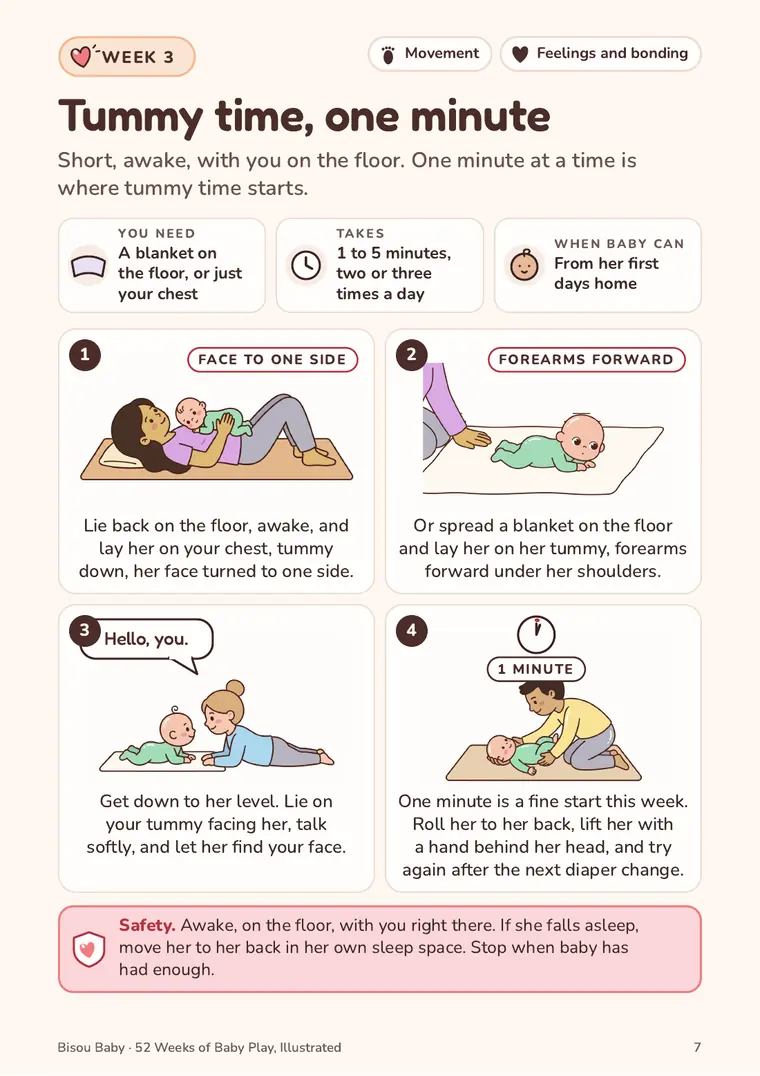
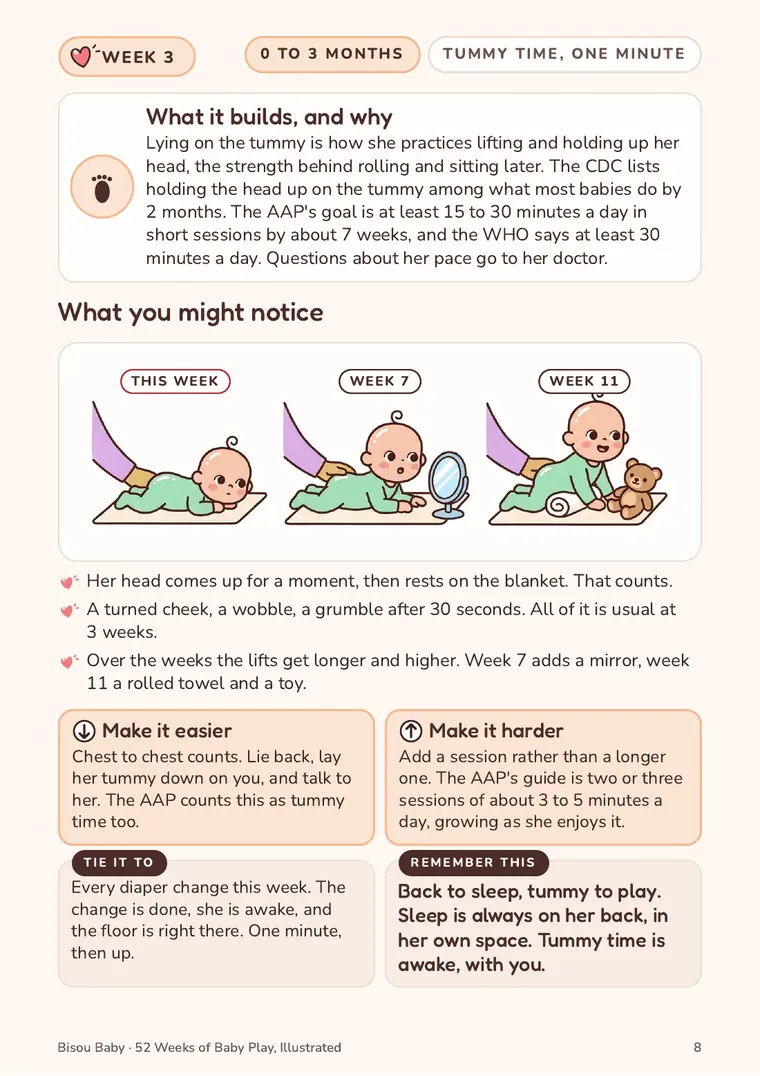
Every week has the same four parts, so you always know where to look. Here is Week 3, Tummy time, one minute, with its lines quoted from Book 1.

Awake, on the floor, with you right there. If she falls asleep, move her to her back in her own sleep space. Stop when baby has had enough.
A turned cheek, a wobble, a grumble after 30 seconds. All of it is usual at 3 weeks.
Chest to chest counts. Lie back, lay her tummy down on you, and talk to her. The AAP counts this as tummy time too.
Add a session rather than a longer one. The AAP's guide is two or three sessions of about 3 to 5 minutes a day, growing as she enjoys it.
Quoted word for word from Book 1, Week 3, Tummy time, one minute. Every week carries these four lines, plus the steps, what it practices and two extras.
The play book. One activity a week on a two-page spread: a Do it page with the steps drawn, and a Why page with what it practices in the CDC's or the AAP's words, what you might notice, an easier and a harder way, and two extras such as a line to say or a note for the other grown-up. Four age bands, 0 to 3, 4 to 6, 7 to 9 and 10 to 12 months, and five areas of play: movement, hands and senses, talking and listening, feelings and bonding, thinking and exploring.
One card a week, with the week's steps redrawn to card size and its "what it practices" line. Every line is Book 1's line, word for word. Keep this week's card on your phone, or send it to the other grown-up or the grandparents, so everyone has the same five minutes.
The lookup guide for the eleven minutes before the next feed. Pick up the thing in your hand, or look up the moment you're in, and read the line for your baby's age. 40 household objects, plus your hands and your face, and 20 everyday moments such as the diaper change, the laundry and the waiting room, with three or four plays each by age band.
Total value: $77
One-time payment. No subscription. Keep the files forever.
Digital books (PDF), in English. We email your library link right after purchase, and you can download the files again anytime. Plus sales tax where applicable.
Bisou Baby is an independent play guide for parents. It is not medical advice and does not replace your child's doctor. Every baby develops at their own pace.
The feeds and the changes have a rhythm. The awake windows don't. This gives each one a plan: one drawn thing to try, and the reassurance that a baby who just stares back is doing exactly what the week expects.
An hour of awake time after daycare, and you want it to be more than the same rattle. One card on your phone says what to do tonight, and the other grown-up can read the same card tomorrow.
Grandparents, friends and baby showers. It lasts the whole first year, it never needs batteries, and the Weekly Cards give whoever is holding the baby the same five minutes. Buy it with the recipient's email, or forward your library link.
No gimmicks. Public guidance from the CDC and the AAP, drawn clearly, with the source on the page.
What each activity practices is written in the words of the CDC's milestone checklists and the AAP's published guidance, with the source named on the page. These describe what most babies do by an age. They are not goals, tests or promises.
Twenty-two rules, built from CDC, AAP, NIH, WHO and CPSC safety guidance: tummy time awake and on the floor, head supported, no small parts, no walkers, stop when baby has had enough. Where a rule is ours rather than a source's, the page says so.
Tummy time totals differ between the AAP and the WHO, so the page gives the range and names each. No activity is ever framed as a test, and no baby as late.
Not affiliated with or endorsed by the CDC, the American Academy of Pediatrics, the NIH, the WHO, the CPSC or any hospital or health system. We answer to the parent on the floor, not to a publisher.
Use the kit for 7 days. If it isn't for you, email us and you get 100% of your money back. No fine print, no hassle.
Right after purchase we email you a link to your library, where you download all three books as PDFs. You can come back and download them again anytime.
One-time payment of $24. No subscription, no recurring charges, and nothing else to buy.
Baby's first year, from the first week home to the first birthday. Book 1 is 52 weeks in four age bands: 0 to 3, 4 to 6, 7 to 9 and 10 to 12 months. Start at your baby's band, whatever week you buy it. Find your baby's week.
No. Every activity uses things already at home: your face, your hands, a blanket, a wooden spoon, a metal bowl, a cardboard box, a scarf. Everyday Play is a whole guide to playing with what you already own.
Both. The pages are portrait and phone-sized, and the Weekly Cards come as a phone-size PDF, one card front and back. A US Letter print file puts two cards on a page for the fridge. The screen is for you to read; the activities themselves are screen-free.
No. Bisou Baby is an independent play guide for parents. It is not medical advice and does not replace your child's doctor. Every baby develops at their own pace. Questions about your baby's pace go to your baby's doctor.
Start at the band that fits your baby today, not the calendar, and go at your own pace. A week from an earlier band is never wrong. Every baby develops at their own pace, and your baby's doctor is the right person to ask about anything specific to your baby.
Yes. The library link goes to the email you enter at checkout, so you can buy it with the recipient's email and they get the link straight away, or buy it with your own and forward the link. The Weekly Cards are made for sharing with whoever is holding the baby.
Email us within 7 days of purchase and we'll refund 100% of your money. Details on the refund policy page.
No. Bisou Baby is an independent play guide built on their public guidance, which is named on the page as a source. It is not affiliated with or endorsed by the CDC, the American Academy of Pediatrics, the NIH, the WHO, the CPSC or any hospital or health system.
Spotted an error, or a week that didn't work for your baby? Email [email protected]. A real person reads every message, and fixes go into the next version.
The first year goes fast, and the awake windows are where it happens. You don't need a toy box or another app. You need one drawn thing to do this week, and the reason it counts.